01 — Background
Children with developmental delays have a critical window in their first three years of life to build foundational skills — physical, cognitive, communication, social/emotional, and self-help. Miss it, and the gap compounds.
In Singapore, the current standard of care provides each child 2–3 therapy sessions per week, 2 hours each. At most, that's 6 hours of structured intervention in a 168-hour week — covering less than 8% of a child's waking hours.
Each child is assigned 3–6 individualised goals to achieve within a 6-month term. Yet the primary vehicle for reaching those goals covers less than one hour in twelve.
The question this raised: What happens in the other 96%?
Caregivers are present for those hours. But without guidance, they default to instinct. There's no structure, no scaffolding, and no visibility into whether daily interactions are reinforcing or inadvertently working against the child's goals.
The opportunity hypothesis: If caregivers could be guided to perform targeted intervention tasks at home — aligned to their child's active goals — cumulative practice time per goal could increase dramatically, raising the probability of goal attainment within each term.
02 — Market Segments
Early intervention in Singapore is growing fast. The total number of children enrolled in government-supported EI programmes more than doubled from 3,824 in 2015 to 9,850 in 2023 — a 2.6x increase driven by greater awareness, earlier detection, and expanded service capacity.
Despite this growth, demand outpaces supply. Government-funded centres carry wait times of 8–12 months, pushing families toward private providers at higher out-of-pocket cost. Three structural trends are amplifying the gap:
- Greater awareness and earlier detection — developmental screening is now more widespread, identifying delays sooner and generating more referrals
- Expanded service capacity — more centres and therapists are entering the sector, but not quickly enough to absorb rising demand
- Enhanced support systems — government policy and family subsidies are reducing barriers to access, increasing the eligible population
This creates a sector where families are waiting longer, paying more, and expecting measurable outcomes. A product that makes home practice trackable, guided, and clinically valid addresses a gap no existing tool has solved.
03 — Discovery & Research
Goal
Extend the effectiveness of centre-based therapy into the home environment by equipping caregivers with the guidance, confidence, and accountability to practise interventions correctly and consistently between sessions.
I ran a 4-week discovery sprint before any build decisions were made. Direct access to an Early Intervention Centre enabled structured interviews with 4 therapists and 20 caregivers across a single site.
User Interviews — Therapists
Two consistent pain points emerged:
Correction Lag. Errors in home technique go undetected until the next caregiver check-in session — up to 2 weeks later. By then, incorrect patterns may already be reinforced in the child's behaviour.
Context Breakdown. Caregivers are taught correct technique inside the centre, in a controlled environment with therapist guidance. At home, the environment changes and the child behaves differently. When deviations happen, caregivers get stuck — and without immediate support, they either execute incorrectly or stop altogether.
This is compounded by a structural capacity constraint. With a therapist-to-client ratio of approximately 1:30, ad-hoc WhatsApp support is not operationally viable. When caregivers reach out between sessions, responses are delayed or inconsistent — leaving them without support precisely when they need it most.
User Interviews — Caregivers
Barriers to compliance were rarely about willingness. The breakdown happened at the execution layer.
Caregivers could follow along and replicate exercises correctly during centre sessions with a therapist present. But at home, the moment a deviation occurred — the child resisted, reacted differently, or the caregiver couldn't recall a specific step — confidence collapsed. Without anyone to check with in real time, most stopped rather than risk doing it wrong.
A short survey of the 20 caregivers found that 18 out of 20 (90%) had not attempted their assigned home exercise in the week prior to their check-in session. The top cited reason: lack of confidence in performing the intervention correctly.
Synthesised Pain Points
Mapping therapist interviews against caregiver interviews revealed strong convergence — both sides describing the same broken loop from opposite ends:
- Confidence Gap — Caregivers can perform exercises in the centre but doubt themselves at home when deviations occur. Fear of doing it wrong results in stopping entirely.
- No Real-Time Support — Caregivers have no way to get immediate guidance when stuck. Therapists managing a 1:30 client ratio cannot offer scalable ad-hoc support.
- Feedback Delay — Errors go uncorrected for up to 2 weeks until the next check-in. Too slow to course-correct meaningfully within a 6-month term.
04 — Minimal Viable Product
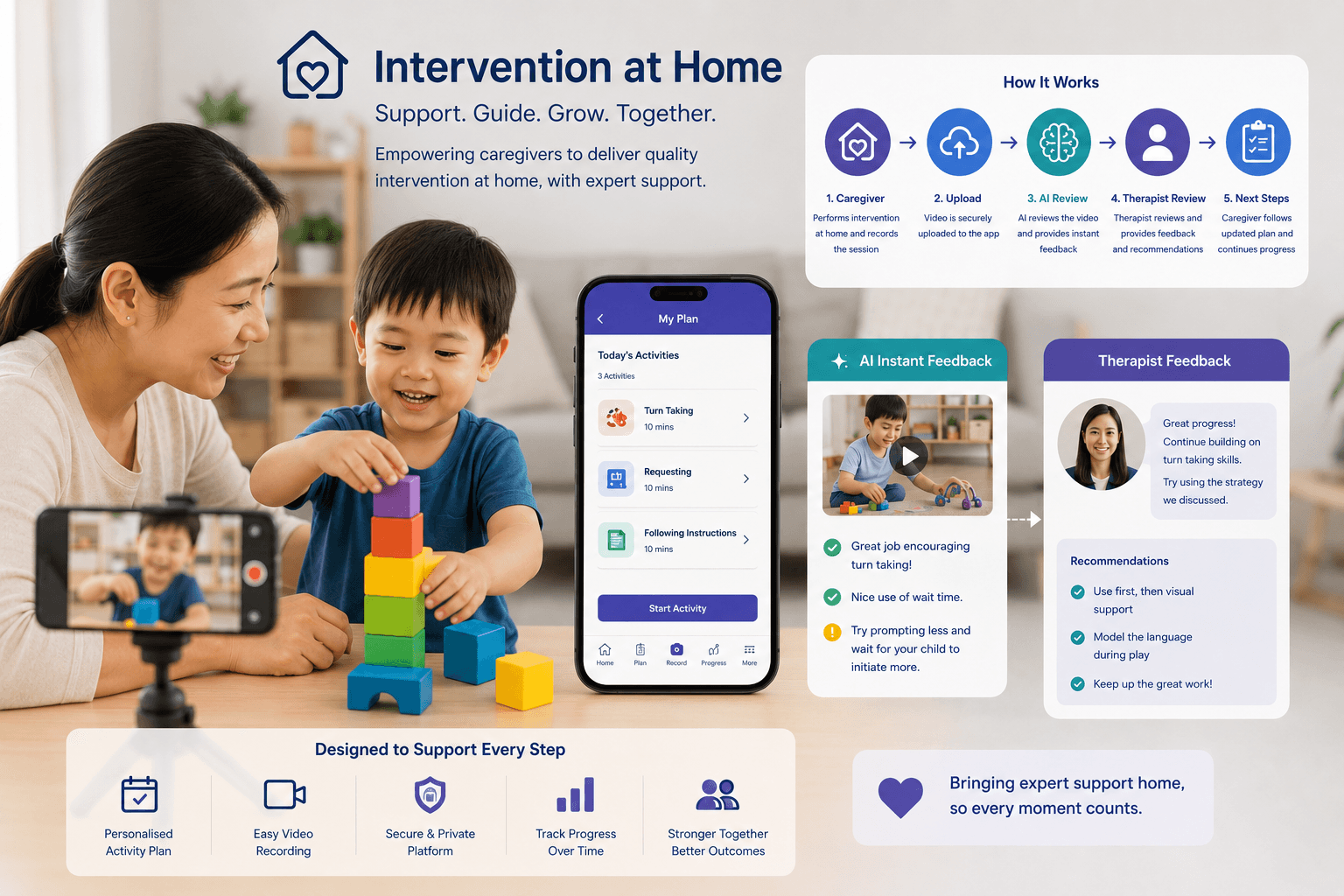
The MVP was scoped to test one hypothesis: structured home practice with near-real-time feedback changes caregiver behaviour. Four user stories represent the minimum functionality needed to validate this.
US-01 · View Assigned Intervention Tasks
As a caregiver, I want to see a clear list of intervention tasks assigned to my child so that I always know what I should be working on at home.
Acceptance Criteria
- Caregiver can view all currently active intervention tasks in a single view upon logging in.
- Each task displays the associated intervention goal it is working towards.
- Tasks reflect the current term's assignments — outdated or completed tasks are visually distinguished from active ones.
US-02 · Access Task Instructions
As a caregiver, I want to access clear step-by-step instructions for each intervention task so that I can perform them correctly at home without needing to contact the therapist.
Acceptance Criteria
- Each task includes instructions in at least one of the following formats: text, image, or video.
- Video format is the default where available — it most closely replicates in-session demonstration.
- Caregiver can replay or revisit instructions at any point before, during, or after performing the task.
US-03 · Submit Performance Video & Receive Feedback
As a caregiver, I want to submit a video of myself performing an intervention task with my child so that I can get timely feedback from the therapist and be confident I am doing it correctly.
Acceptance Criteria
- Caregiver can record or upload a video directly within the task view.
- Submission is linked to the specific task and visible to the assigned therapist.
- An AI review is triggered automatically upon submission and delivers initial feedback to the caregiver within minutes — flagging any obvious errors in technique or execution.
- AI feedback is presented as a checklist against the task's key steps, clearly showing what was performed correctly and what needs correction.
- Therapist receives the submission alongside the AI-generated feedback for context, and provides a human follow-up response within 1–2 business days.
- Caregiver receives a notification when therapist feedback has been posted.
- Submission status is visible to the caregiver — showing whether AI review is complete, therapist review is pending, or feedback is ready.
US-04 · Set Task Reminders
As a caregiver, I want to set reminders for my child's intervention tasks so that completing them becomes a consistent daily habit rather than something I have to remember on my own.
Acceptance Criteria
- Caregiver can set a recurring daily or custom reminder for each active task.
- Reminder is delivered via push notification.
- Tapping the reminder navigates the caregiver directly to the relevant task — not the home screen.
05 — Go-to-Market
Phase 1 — Controlled Pilot
Objective: Validate that the MVP meaningfully improves caregiver engagement and correct task execution in a real-world setting.
Scope: 1 centre, minimum 20 caregivers selected based on digital comfort and willingness to provide structured feedback. All 4 MVP user stories in scope.
Starting with higher digital literacy reduces the risk of drop-off caused by onboarding friction rather than product-market fit issues — giving a clean signal on whether the core product works before testing whether it works across all caregiver types.
Phase 2 — Iterate & Full Centre Rollout
Objective: Incorporate Phase 1 learnings, resolve friction points, and expand to the full caregiver population across all 5 centres.
Trigger: Phase 1 success criteria met and at least one full term of data collected.
Key activities:
- Synthesise Phase 1 feedback into a prioritised iteration backlog; fix critical usability issues before expanding
- Extend onboarding to all caregiver types including less tech-comfortable users such as grandparents and family helpers — may require simplified flows or in-person setup support
- Roll out across all 5 centres and onboard all active caregivers
- Train therapists and centre coordinators across all sites on the feedback workflow and video review process
- Establish a baseline dataset across the full centre network — goal attainment rates, task completion rates, video submission rates — to inform the Phase 3 expansion pitch
Phase 3 — Market Expansion
Objective: Scale the platform beyond the initial centre partner.
Go-to-Market Motion: Position the product as a white-label or licensed SaaS offering for Early Intervention Centre operators — giving each centre their own instance where therapists manage tasks, content, and caregiver relationships under their own brand.
Target Customer: EI Centre operators looking to improve caregiver engagement, differentiate their service offering, and demonstrate measurable goal attainment outcomes to parents and funders.
06 — Metrics Framework
North Star Metric
Weekly Active Caregivers — View & Submit
The percentage of enrolled caregivers who both view at least one intervention task AND submit at least one performance video in a given week.
This metric combines two distinct behaviours: engagement (viewing instructions) and follow-through (submitting a video). A caregiver who only views tasks but never submits may be passive. A caregiver who submits without reviewing instructions may be performing incorrectly. Both behaviours together are the closest proxy to what the product is designed to achieve.
| Phase | Target |
|---|---|
| Phase 1 | ≥ 40% of enrolled caregivers |
| Phase 2 | ≥ 60% of enrolled caregivers |
Leading Indicators
Early signals of whether the product is driving the right behaviours — these move before the North Star does.
| Metric | Definition | Why It Matters | Phase 1 Target |
|---|---|---|---|
| Task View Rate | % of assigned tasks viewed per caregiver per week | Indicates whether caregivers are accessing instructions — the first step before any execution can happen | ≥ 70% |
| Video Submission Rate | % of caregivers submitting at least 1 video per week | Direct signal of behavioural follow-through | ≥ 40% |
| Therapist Response Time | Average time between video submission and therapist feedback | A slow feedback loop will erode caregiver trust and submission behaviour | ≤ 2 business days |
Lagging Indicators
Outcome measures that confirm whether the product is delivering real-world impact. Measured per term or at 6-month intervals.
| Metric | Definition | Why It Matters |
|---|---|---|
| Child Goal Attainment Rate | % of individualised goals achieved per child per 6-month term | The ultimate measure of whether home practice is translating to developmental outcomes |
| Caregiver Satisfaction Score | Caregiver-reported satisfaction with the platform | Measures perceived value and likelihood of continued engagement |
| Therapist-Reported Compliance Improvement | Therapist assessment of caregiver compliance vs. pre-product baseline | Provides a clinical perspective on whether home practice quality has improved |
Pre-product baseline: Prior to the pilot, estimated caregiver task compliance with printed take-home sheets was approximately 10% weekly, derived from therapist-reported observations. All lagging indicators are benchmarked against this baseline.
Counter Metrics
Guardrail metrics that ensure the product isn't creating new problems while solving existing ones.
| Metric | Definition | Risk It Guards Against |
|---|---|---|
| Therapist Review Burden | Average number of videos submitted per therapist per week | At a 1:30 client ratio, high submission volumes could overwhelm therapists and break the feedback SLA |
| AI Feedback Escalation Rate | % of AI-reviewed videos flagged as ambiguous and escalated to therapist | A high escalation rate signals the AI model is not reducing therapist workload — the core promise of US-03 |
| Caregiver Task Overload Rate | % of caregivers with 0 submissions despite active reminders | Signals caregivers may be overwhelmed by task volume — a risk of disengagement or abandonment |
Monitoring Metrics
Operational metrics tracked continuously to maintain platform stability.
| Metric | Definition |
|---|---|
| Video Upload Success Rate | % of video submissions that upload without error — home connectivity is a real variable |
| App Crash Rate | Frequency of crashes per session — critical for caregiver trust in the platform |
07 — Outcome
The MVP pilot completed successfully across a single term with 20 caregivers. All Phase 1 success criteria were met — task view rates, video submission rates, therapist response times, and CSAT scores all hit their respective targets.
Caregivers who previously cited lack of confidence as their primary barrier to home practice demonstrated consistent task engagement when given on-demand instructions and a direct video feedback channel. Therapists reported spending less time on retrospective correction during check-in sessions — errors were being caught and addressed within 1–2 days rather than the previous 2-week lag. With the core hypothesis validated, the decision was made to proceed to Phase 2.
What I'd do differently: The AI feedback layer took two iteration cycles to get right. The first version flagged technique issues in language that read as corrective rather than supportive — some caregivers reported feeling like they were failing, which was the exact opposite of the intent. I should have stress-tested the feedback tone with caregivers earlier in the build. The lesson: in contexts involving vulnerable users, the emotional register of feedback matters as much as its clinical accuracy. Validate tone separately from content.