The Problem
Cyberland's Activity Album is a feature that lets SMB clients document and share operational activities — job completions, site visits, service records — with their end customers. It was one of our most strategically important features for client stickiness, but adoption was stuck.
Only 30% of eligible clients were using Activity Album regularly. The rest had either tried it and stopped, or never engaged meaningfully. We were leaving a high-value feature underutilised, and that had downstream consequences: clients who didn't use Activity Album had measurably lower retention.
My Role
I owned the diagnosis, ideation, and validation process. I worked closely with our engineering team to define the A/B testing framework and with our partner clients to run the test.
Diagnosing the Friction
My first instinct was that the issue was discoverability — clients didn't know the feature existed. But our analytics told a different story: clients were opening Activity Album. They were starting to create entries. And then abandoning them.
The drop-off was happening at the caption step.
I ran qualitative sessions with 10 clients who had abandoned Activity Album creation mid-flow. The feedback was consistent: writing a caption felt like extra work. Many of their end customers were mobile-first, WhatsApp-native users who expected visual, polished updates — but the field workers uploading activities were not comfortable writers. Staring at a blank text box with a photo they'd just taken felt like homework.
The insight: the barrier wasn't awareness. It was the cognitive effort of captioning.
The Solution
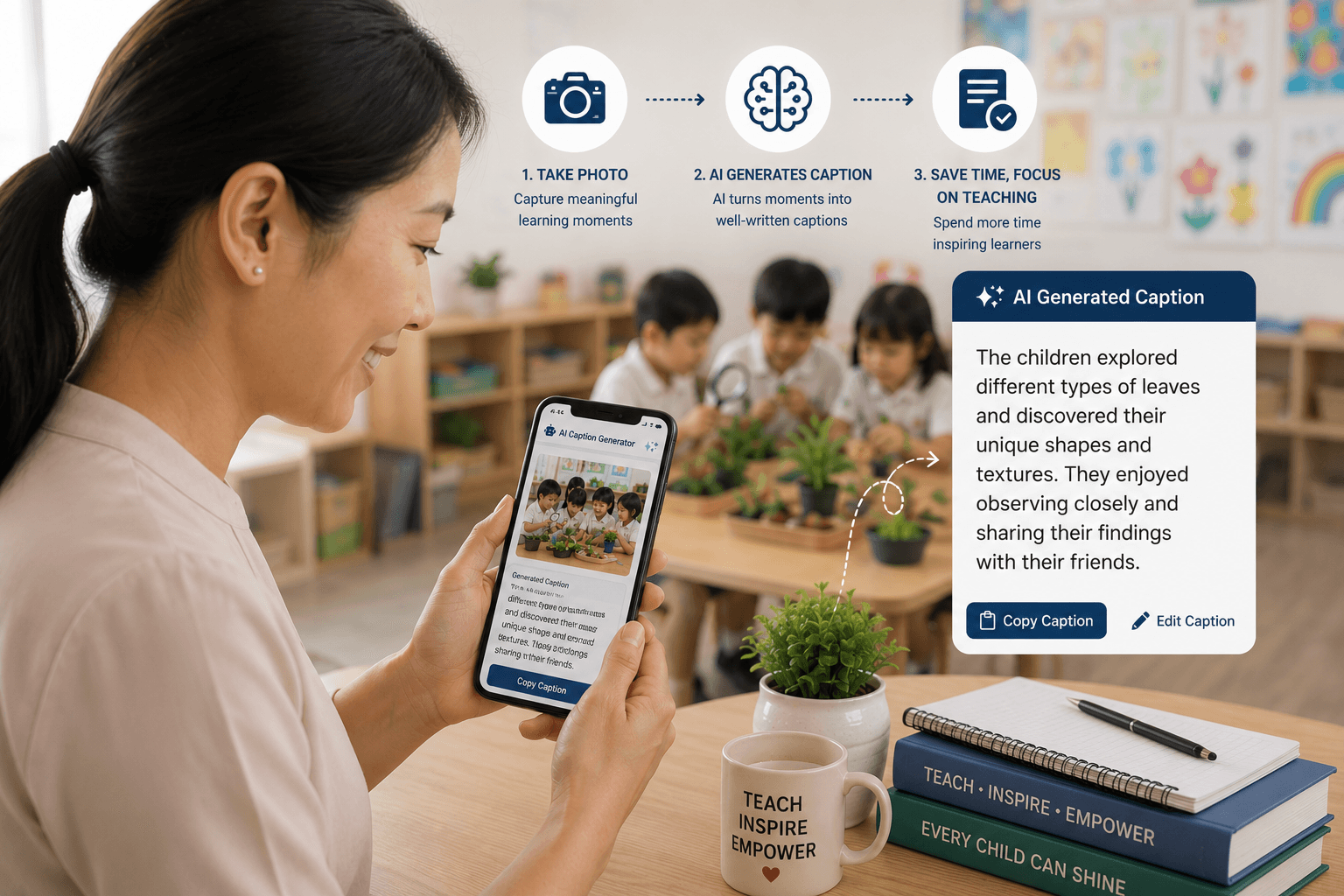
I proposed an AI caption generator that would auto-generate a suggested caption based on the uploaded photo and the activity type selected. The user could accept it, edit it, or ignore it entirely — no lock-in.
This was a deliberately low-risk bet: we weren't forcing AI on anyone, just reducing the blank-page problem. If the suggestion was good enough to accept, the user saved effort. If it wasn't, nothing changed.
I wrote the product spec, defined the UX (inline suggestion below the photo, single-tap to apply), and worked with engineering on the prompt design to ensure captions matched the professional but accessible tone our clients' customers expected.
The A/B test design:
- Control: existing Activity Album flow with blank caption field
- Treatment: same flow with AI-generated caption suggestion pre-populated
- Success metric: Activity Album entry completion rate
- Secondary metric: time-to-complete per entry
- Run duration: 3 weeks across a cohort of partner clients who had consented to testing
What Made This Work
Two things. First, the specificity of the diagnosis — I didn't treat this as a general engagement problem. I found the exact friction point (the caption field) before proposing anything. A generic "improve Activity Album" initiative would have produced a roadmap of guesses.
Second, the A/B test design. Running this with partner clients who had opted in meant we got clean signal without contaminating our broader base. The opt-in dynamic also meant these clients felt like collaborators, not test subjects — which improved the quality of their feedback beyond the raw metrics.
What I'd Do Differently
The initial AI caption quality was inconsistent for niche activity types (e.g. very specialised trade work). I should have built a feedback mechanism into the feature from day one — a simple thumbs up/down on the suggestion — so we could continuously improve the prompt logic based on real rejections. Instead, we relied on anecdotal feedback from the test cohort, which was useful but not systematic.